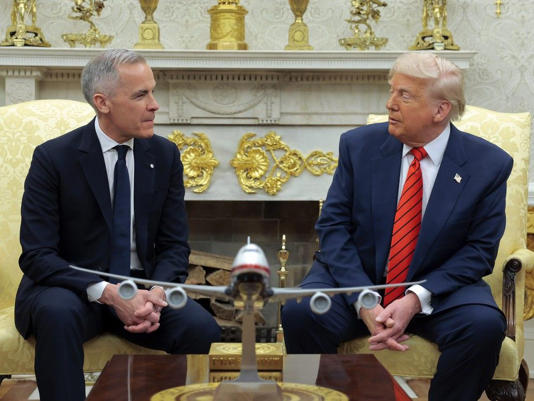
It was not that long ago, merely March, when Prime Minister Mark Carney, fresh off his Liberal party leadership win, began telling Canadians his party needed a “strong mandate” because Canadians were “facing the most significant crisis of our lifetimes because of President Donald Trump’s unjustified trade actions and his threats to our sovereignty.” He insisted a snap election was essential, as was electing him, the self-proclaimed “crisis manager,” to address it.
The election is over now. Where’s the “crisis,” Carney?
In late March, pollster Nik Nanos found that Canadians’ top concern was “the potential negative fallout of Donald Trump and the threatened tariffs.” That concern quickly shifted. By mid-April, 34.3 per cent of those polled ranked Trump and U.S. relations as the biggest issue. A month later, by mid-May, that number plummeted to 19.3 per cent, with jobs and the economy taking precedence.
So, what happened?
Did Carney give Trump the old “elbow’s up” so hard he submitted? Did he pull Trump’s blazer over his head, as if in a Molson’s “I am Canadian” commercial ? Did the two face off in an Epic Rap Battle , an eagle over Trump’s shoulder and a beaver on Carney’s back, with Carney emerging victoriously after some sick disses?
Hardly. Closer to the opposite, actually.
Six days into the campaign, on March 28, Carney gave Trump a heads up in a phone call that he’d be talking about him during the campaign. In that same call, Carney flattered Trump, calling him “ transformative president .” The PMO’s press statement , of course, did not mention these details. There were four more weeks until election day, after all.
Sounds like any “crisis” ended there.
Why else would Carney feel comfortable enough to share his campaign strategy with Trump? That’s not the kind of card one shows their professed political enemy. It’s something a politician would reveal only to someone they trust, as it could easily backfire.
Carney made Canadians the butt of an inside joke between himself and an American president. Imagine how powerful that would have made Trump feel.
After this cordial chat, Carney kept piling on the crisis rhetoric. At a mid-April Hamilton campaign event, Carney warned that Trump’s “strategy is to break us so America can own us.” This was reportedly met with boos, assumedly directed at the U.S. president.
Carney also suggested there was going to be a historic change in Canada’s relationship with the U.S., often repeating the claim that the “old relationship we had with the United States based on deepening integration of our economies and tight security and military co-operations is over.”
Much of Carney’s “our old relationship is over” rhetoric appeared to be based upon the idea that Trump was serious about making Canada the 51st state.
But signs of exaggeration were clear as early as February, during the Canada-U.S. Economic Summit , signs that Canadians should not have bought into any of this. According to the CEO of the Canadian American Business Council, Beth Burke, Trump’s comments were something that “most Americans don’t take seriously.”
Burke told reporters at the summit: “I would say (Americans) don’t believe, generally, that that’s actually something that’s real, or in a real agenda. Instead, I think our perception is more that it is one from a position of negotiation and posturing and using it as leveraging in the conversation.”
This suggests the annexation threat may have never been more serious than the “Oh, Canada,” meme which helped spread it in early December. In the meme, Trump stands on the alps, in full business suit attire, next to a Canadian flag, gazing over at Matterhorn, which is in Switzerland, not Canada.
Either way, the post-election meeting between Carney and Trump did not go as the Liberals’ “elbow’s up” campaign rhetoric suggested.
The warm feelings between the two were palpable. Trump opened by congratulating Carney, complimenting him on how he ran his race, which we know they discussed prior in that phone call.
Carney thanked Trump for his hospitality and his leadership, calling him a “transformational president,” saying he wanted to transform Canada much the same. I guess that’s why he’s been photographed signing all those fake American-style executive orders.
By the end of the meeting, Trump tried to reassure confused reporters that, “Regardless of anything, we’re going to be friends with Canada.”
Weighing in on the Oval Office meeting, the U.S. Ambassador to Canada, Pete Hoekstra, too, confirmed that Canada-U.S. relations were firm, telling National Post’s Stephanie Taylor that the last 90 days were “behind us.”
“A restart or a reset? No way! … We are great friends. We have been great friends for such a long period of time. You’re not going to change those personal relationships. You’re not going to change those economic relationships, national security… The relationship, from my perspective, and, I think, the president’s perspective, was never in jeopardy.” Well, then.
There were other signs things had improved well before election day. Retaliatory tariffs Carney threatened to wage against Trump went elbows down as early as April 16, when his government — mid-election campaign — had decided, according to Bloomberg News, citing an Oxford Economics report, “ suspend almost all of its retaliatory tariffs ” dropping them to “ nearly zero. ”
Asked Wednesday by Global reporter MacKenzie Gray about this apparent about-face on deepening security relations with the U.S., Carney responded with gibberish,”We are in a position now where we cooperate when necessary, but not necessarily cooperate.”
In late March, Carney told reporters “I’ve managed crises before. This is the time for experience, not experiments.”
He’s managed something, alright — a masterclass in political theatre.
tnewman@postmedia.com
X: @TLNewmanMTL
风萧萧_Frank